

 Whether we like it or not, students are already learning with AI. The question is whether schools will shape that learning or leave it to algorithms and their builders.
Maggie Renken, Ph.D., ISM Consultant
I recently led a webinar, Beyond the Chatbot: AI Use Cases to Build Schoolwide AI Literacy,* for school leaders feeling the same tension I’ve watched unfold in schools all year.
Most of the AI-in-education conversation today is about large language models (LLMs) like ChatGPT, Claude, Gemini, and Grok. But even as these LLMs develop more advanced reasoning and agentic capabilities, we’re living through a technological shift much bigger than AI chatbots.
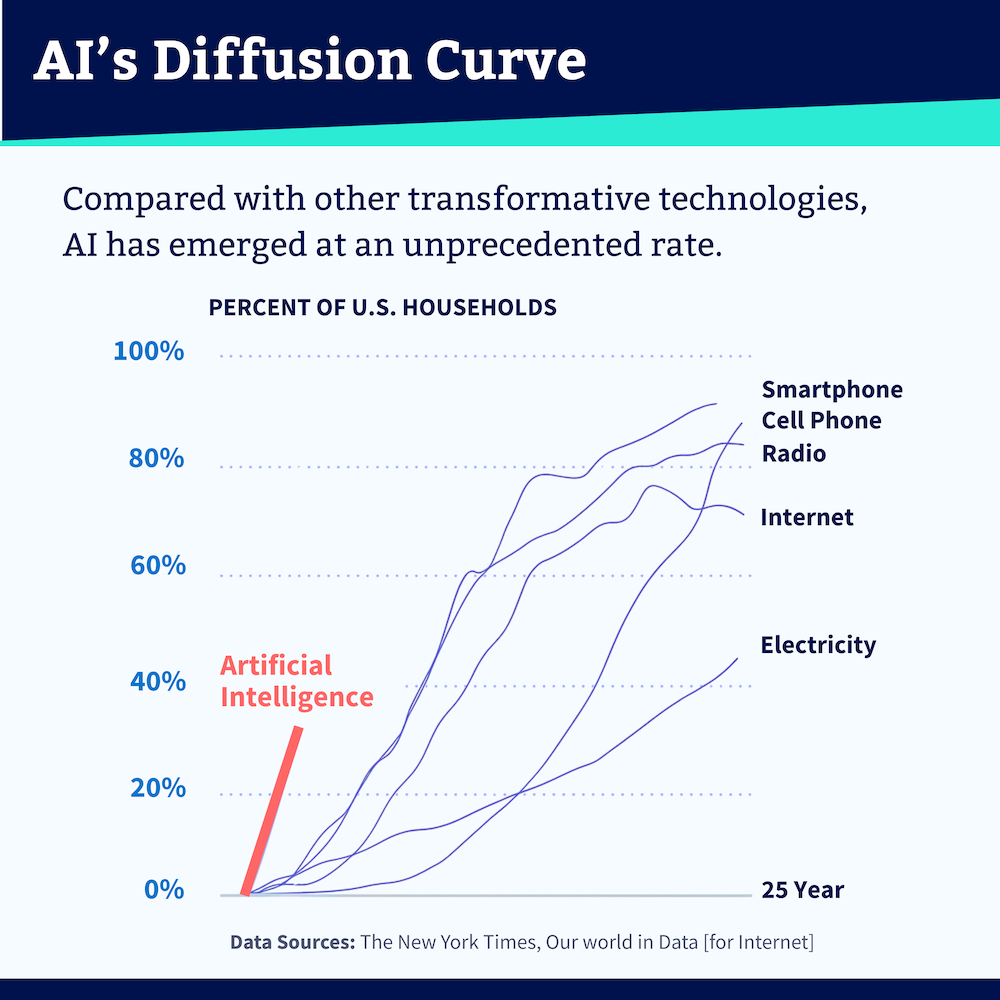
AI isn’t a tool; it’s an arrival technology — the kind that fundamentally alters economic and social structures, reshapes what students need to know, and forces institutions to evolve faster than they planned. Think: the printing press. Electricity. The internet.
While those transformative technologies required decades to emerge, generative AI unfolded in mere weeks.
And because it arrived before our systems were ready, schools face a pivotal moment.
Below is a deeper dive into the four insights I shared in the webinar, written for school leaders, trustees, academic teams, and anyone tasked with stewarding a mission-driven future for students.
1. AI Is the Fastest-Spreading General-Purpose Technology in History
At this moment, schools are no longer "adopting" generative AI — none of us are. It is embedded into into every aspect of our lives:
- Google Workspace
- Microsoft 365
- Adobe tools
- TikTok, SnapChat, and Instagram
- Chrome browsers
- Search engines
- Learning platforms
- Student workflows
- Parent communication behaviors
Whether we like it or not, students are already learning with AI. The question is whether schools will shape that learning or leave it to algorithms and their builders.
This is why AI literacy is already treated as a national priority by the Organization for Economic Cooperation and Development (OECD) and U.S. Department of Education. The OECD AI Literacy Draft Framework calls for engaging with, creating with, designing, and managing AI.
Schools that wait to take ownership of AI literacy risk graduating students into an already AI-driven world with a skillset built for 2019, not 2030.
2. Off-the-Shelf LLMs Come With Real Pedagogical Limitations
Despite their fluency, LLMs (which have not been trained to behave like tutors) still struggle with:
- Answer-bot behavior — collapsing student thinking into shortcuts
- Wall-of-text explanations that obscure conceptual understanding
- Misalignment with student confusion
- Empathy simulations rather than the relational attunement teachers provide
These limitations align with what recent research is revealing as risks to metacognition, self-regulation, and knowledge construction.
None of this means schools should avoid generative AI. It means:
- Teachers need upskilling opportunities in the form of ongoing (not one-off) professional development.
- Teacher judgment matters more, not less.
- Schools must teach students when, why, and how to use AI, not just whether or not to use it.
- AI literacy must be as foundational as reading and writing.
3. Schools Need Strategic, Mission-Aligned AI Adoption
The feverish pace of AI tools entering students’ personal tech stacks is disorienting, especially for schools. In the webinar, we walked through the ISM AI Readiness Framework’s 10 dimensions that help schools evolve coherently and calmly instead of reactively.
A few essential takeaways:
- Anchor your decisions in mission and the future your school promises families
- Build cross-functional leadership capacity before implementing tools
- Develop a comprehensive AI literacy plan for students, faculty, and families
- Create ethical governance that builds trust
- Design curriculum intentionally, not defensively
The bottom-line: AI is not a technology initiative. It is a whole-school change initiative. Schools that thrive in the AI era treat AI readiness the same way they treat safety, belonging, or long-range financial planning, not as an “ed tech” conversation.
4. Government & Institutional Momentum Has Shifted
AI in schools is no longer a fringe or experimental moment.
A wave of recent reports published this fall are shaping national and international priorities: the MIT Teaching Systems Lab report (2025), Cambridge’s Preparing Learners to Thrive in a Changing World, the Microsoft AI Diffusion Report, and the OECD literacy framework.
Collectively, they signal the same message: AI readiness is now an institutional expectation.
State agencies, accrediting bodies, and global organizations are aligning around literacy, governance, teacher training, and safety. Independent schools will need to keep pace if they want to remain relevant and trustworthy to families.
Five Use Cases That Move Schools Beyond the Chatbot
To effectively shift the conversation in response to current key themes in the AI-in-education landscape, schools should start by leveraging practical AI literacy activities that span grades PreK–12. This approach focuses on real-world use-cases, demonstrating that AI literacy relies on learners’ embodied technical understanding, not just typing into tools like ChatGPT.
These are some of my favorite (and for more inspiration follow Code.org’s Hour of AI or ISTE’s AI Curriculum Resources):
- A PreK–K Activity with Cubelets for engaging with emergent AI concepts (sensing, acting, systems thinking)
- A Grades 3–5 Activity with Teachable Machine to create supervised learning models and reflect on model training and bias
- A Middle School Activity with Pepper Robot to design multilingual welcome experiences
- An Upper School Activity with digital portfolios that teach critical AI management and a dose of vibe coding
This is what AI literacy can look like for the whole school, not just for the high school English department.
Let’s Build AI Literacy That Centers Human Learning
We don’t teach kids about nutrition by banning food. We teach them to eat well.
The same must be true for AI.
How do we get there? Curriculum should be adapted to accommodate AI literacy. Leadership teams need to implement:
- Mission-aligned vetting matrix–for tool selection.
- Activity log–to celebrate wins and "fail forward" safely.
If your school is ready to design a future-focused approach, or if you need help building your AI Planning Committee and literacy roadmap, I’d love to talk.
Email: mrenken@isminc.com
Together, let's build schools that help students thrive in a rapidly changing world.